Thursday, February 13, 2014

Exclusive “Leather Life” interview: Joseph D.R. OLeary, author/photographer of Of Beards and Men

(Published in Lavender Magazine, Issue #488, February 13, 2014)

I recently interviewed Joseph D.R. OLeary, the creator, photographer, author and publisher of a new book called Of Beards and Men. The interview took place in OLeary’s office at his farm just outside the Twin Cities area of Minnesota.

Author Joseph D.R. OLeary
What all do you do? You’re a photographer, you have your own design firm, you’ve got a farm—

I went to school for design. I always did photography on the side. I had my first camera when I was eight. I had a darkroom growing up, I was always interested in it. But I really liked design and focused on design for my schooling. I started Veto Design in January 1992, the year I graduated [from Minneapolis College of Art & Design]. I did photography here and there while I was living in Minneapolis. And then eight and a half years ago, when I moved here, I had the luxury of having a couple barns that I could remodel into a studio. And that’s when I got more serious about the photography—now I can dedicate a whole space to this, and keep things there, I don’t have to like shuffle things around as much.

The farm, at various points we had chickens, we had goats, we had different things. Right now we don’t have anything—except the dog.

Why beards? Why a book of photographs of men with beards?

Several reasons. I was doing a portfolio of women’s fashion because I wanted to get jobs in the fashion industry. And it wasn’t working very well. When I would contact somebody they’d be like, oh, your work is great, I’d love to work with you. Then they would find out that I lived out here, and they wouldn’t show up. I had probably a 50% show-up rate.

So that was one thing. Secondly, my brother died in a car crash in December of 2011, which kinda made me spiral out of control a little bit. This project was a way of connecting with people to tell their story, so that it’s documented in a book for, like, an eternity. Because I felt like my brother was taken from us too fast, and unexpectedly, so his story was never told in this way.

And then I got Lyme disease in 2012, which I had for six months to a year prior to when they discovered it. It was crippling, I was on crutches for five months during 2012 and nobody could figure out what was wrong with me. I was just trying to motivate myself to keep on going, keep moving forward, and this project just kinda came out of it. So it was a way of connecting with people, you know, trying not to drop out of society because I was sick and hurting from my brother’s death.

But why men with beards? You could have taken photographs of anybody or anything.

Well, I think because the women weren’t showing up, I thought, let’s change to men. And I felt beards were just—I would look at old books, like my partner has a book of some of his relatives. There’s 20 brothers in this photograph, these 20 brothers are standing in a V with Mom and Dad in the center, and every one of them had a beard or a mustache. And it was like, wow, there’s something so attractive about this, you know? My dad always had a beard the entire time I’ve been alive. Beards represent masculinity. It’s one physical difference between men and women, you know, men can grow beards.

Chris
How did you find guys to photograph?

I made postcards that said “Is your beard ready for its closeup?” and dropped them at various public places around town. I started putting it online on Facebook—you know, is there anybody out there with a beard who wants to get photographed? It was really slow at first because people weren’t sure what it was all about and, well, what is he gonna do with me while I’m at the studio? I had a couple people who said, well, I’m not into beard fetishes. And it’s like, well, it’s not a fetish, it’s just you have a beard and I’m making portraits of men with beards. Slowly, once people started seeing the photos, it was like, oh, I get it, and then it was easier to get people to come out here.

Tell me about the photographic style of the book.

When I first started the project, I handed out postcards at the Minnesota Beard-off in 2012. I showed up at First Avenue and I was handing out these cards, and before I even left the bar I already had people taking pictures of themselves and e-mailing their selfies to me. This was on Saturday night, and I think I had my first shoot on the following Wednesday. I photographed him, probably for a half-hour, and I was kind of uncomfortable because I didn’t really know what I was doing. The next guy came maybe a week later, and I photographed him. I had six or seven of them done at one point, and I was looking at them, thinking they don’t feel different enough or unique enough, there’s no style to them yet. I haven’t figured out what my voice is about this project. I wasn’t bringing anything new to this subject matter.

That’s when I photographed one guy with a pipe—he was number 6 or 7 or 8—and when he brought his pipe I was like, that’s it, I need people to bring something.

Jesse
You needed props.

Yeah, I needed a prop, something that defined that person. So I asked them to bring a couple changes of clothes, and a prop or two that defined them professionally, personally or spiritually, and then just waited for them to show up. The first few guys that I photographed, I invited them back and I re-photographed them.

Sometimes it took a long time to get the right photo. My photo shoots, the first ones were about a half hour to 45 minutes. As the project went on, they got longer and longer and longer. I would say three and a half hours ended up being the shortest, and sometimes as much as five, six, seven hours. Because I was enjoying the conversation so much, I didn’t want to just take their photo and tell them to get out of here. I wanted to know these people, and I felt like I became friends with all the subjects that I spent a lot of time with. We had great conversations. There was times when I was crying because we were sharing stuff that was unbelievable! I felt like, in a way, these guys have all become my brothers. It was such a personal project to me.

Tim
Why did you use Kickstarter to create this book?

Originally my idea was that it would just be a print-on-demand book—I’ll take the photographs, I’ll design it, put it out on a website, let people buy it if they want. I photographed people, and I got to, like, 50, and the project kept evolving, and more and more people got excited about it. At one point I was doing three photo shoots a day. I finished photographing the hundredth guy much earlier than I expected. So I kept on photographing, because I was having so much fun. There was gonna be 100 people in the book, it ended up being 140. There were only supposed to be 168 pages in the book, it ended up being 212. I was gonna print in China to keep the expenses low, but I printed in Minnesota, which is a lot more expensive. There was only gonna be one version, there ended up being three. I kinda kept amping it up, because I was happier and happier with the photos, and people were more and more excited. The Kickstarter campaign had a goal of $27,000, I raised $40,000. So—I ran with it.

The Kickstarter project got a lot of press internationally. During the campaign I was contacted by people in Israel, Germany, Australia, New Zealand, England, the Netherlands. Everybody was writing articles about it, and it was featured on forty-some different websites. The Huffington Post covered it. It was amazing. It blew my mind. The day that I launched the Kickstarter campaign it was an instant Kickstarter staff pick. It become the most popular local pick for the Twin Cities.

John
What did you do yourself, and what did you outsource to various helpers?

I did everything from designing all the promotional materials for it, to designing the book, to taking the photographs, to writing all of my stuff in the book. I did have [art critic] George Slade write an essay, [photographer/educator] Doug Beasley wrote a critical essay, and Andy Sturdevant [an arts writer based in the Twin Cities]. [The book also includes a fourth essay by author and photo historian Vicki Goldberg.] Anastasia, a friend of mine, ended up editing the bios—I went through and did my first edit, and then gave them to her to edit them so that each biography was in the owner’s voice and said what they needed to say, but there’s a consistent style to them.

But, yeah, everything was my doing, essentially. I was at the printer from 10:00 on a Friday to noon on a Saturday, checking the pages as they were printed. When I was at the bindery the last two days before my book launch, I folded all the dust jackets.

You folded them personally yourself?

Personally myself. We were trying to get it done, and I knew I had a Saturday book launch and I needed to get as many books done as possible. And I shrink-wrapped a bunch of books, too.

Justin
So, you designed the book, you took the pictures, you did all the pre-production work, you oversaw the printing and binding, and you did all the promotional materials as well.

Yeah. One benefit I think I had in overseeing everything was that I have twenty years of design under my belt, so I know the questions to ask. Every detail, I lived and breathed it.

Why was the book printed and bound in Minnesota instead of in China?

I had gotten a book from another photographer, and this book was so beautiful, I’m like, this is what I want mine to be. And in the back of the book it said “Printed in China.” And then another friend said, you really need to check out this other printer in Singapore. I knew it would cost a lot less to print in China or Singapore. But I really wanted it printed in the U.S., because I feel like everything’s getting sent to China. I won’t even shop at Wal-Mart, why would I send my book to China to be printed, even though I loved the printing that China was doing?

And then as I was talking to a lot of the guys in the book when I was photographing them, they were like, don’t print it in China. This is a book about these men, and it all feels local and regional, so keep it local. People are gonna be upset if you print it in China.

Nellie
Are you pleased with the way things have turned out?

I’m blown away by how well Kickstarter worked. I’m actually super-pleased about the whole project. I was able to have complete control over a creative project from the get-go, with nobody telling me what to do, and see where it goes—to see if I can make the right decisions all along the way. And in general, I feel like I have, I don’t think I made too many errors. I just wanted it to be completely my own decision. It’s a little nerve-wracking, but I think it’s fun, too.

The project has been getting a lot of gallery representation. It was in New Hampshire [Drift Contemporary Arts Gallery, Portsmouth], Florida at the Morean Arts Center [St. Petersburg], the Kiernan Gallery in Virginia [Lexington], and the Netherlands [Galerie Mooiman, Groningen]. It was in the Center Forward exhibition at The Center for Fine Art Photography [Fort Collins, Colorado].

I didn’t want it to be a gay book and I didn’t want it to be a straight book. I wanted to appeal to everybody—male, female, straight, gay. My grandmother, who’s 101 years old, has this book sitting out on her coffee table. And that is awesome, you know, that excites me. I feel proud of that.

Thursday, January 16, 2014

2013 Atons Holiday Fundraiser Benefits Aliveness Project and Clare House

(Published in Lavender Magazine, Issue #486, January 16, 2014)

Some of the food donated to the food drive.
On Sunday evening, Dec. 8, The Atons of Minneapolis welcomed the holiday season with their annual Holiday Fundraiser. The event was held in the Bolt Underground.

Food, drink and camaraderie were in abundance, and the bidding for silent auction items was intense. Everett Allen Photography was on hand to take pictures of attendees with Naughty Santa (Mr. Minneapolis Eagle 2013 Ryan Brown), and Great Lakes Bootblack Kai was shining boots and polishing leathers.

The fundraiser included a food drive that collected over 500 lbs. of food and other supplies to benefit the food shelf at The Aliveness Project. Donations at the door and through the silent auction totaled over $1,300 and benefited Clare House.


Shopping at the silent auction.


Lotsa raffle tickets.


Merry Christmas to all!

Thursday, December 19, 2013

Leather Lens: Mr. Minneapolis Eagle 2014

(Published in Lavender Magazine, Issue #484, December 19, 2013)

Jason Little captured the sash at the Mr. Minneapolis Eagle 2014 contest, which took place at the Minneapolis Eagle complex Nov. 15-17. This year’s Mr. Minneapolis Eagle contest was the largest and best-attended in the event’s history and attracted an unprecedented number of out-of-town visitors.

The weekend started with a Greet-the-Meat party Friday evening in the Minneapolis Eagle. On Saturday afternoon the contestants had their private interviews with the judges, while other weekend attendees enjoyed a Kink U session discussing “Kink on a Budget.”

As Mr. Minneapolis Eagle 2014, Jason Little will represent The Minneapolis Eagle and Minnesota’s leather community in the 35th annual International Mr. Leather competition (<www.imrl.com>), May 23-26, 2014 (Memorial Day weekend) in Chicago.

The contestants in the Mr. Minneapolis Eagle 2014 contest. Left to right: Ivan E. Nuñez, Jason Little (Mr. Minneapolis Eagle 2014), Tim Hotchkin (first runner-up) and Bernd Geels.

Ivan E. Nuñez during the contest’s traditional Keg Walk segment.

Tim Hotchkin during the Keg Walk.

Bernd Geels during the Question-and-Answer portion of the contest.

Jason Little during the Erotic Fantasy portion of the contest.

Seen at the pre-contest party are three out-of-town guest judges for this year’s contest. Left to right are Andy Cross (Mr. San Francisco Leather 2013 and International Mr. Leather 2013); Nick Zuko (Mr. Chicago Leather 2013); and Thib Guicherd-Callin (Mr. Santa Clara County Leather 2012 and first runner-up for International Mr. Leather 2013). Other judges were Daddy Don (International Puppy Trainer 2012); Derek Harley (Mr. Minneapolis Eagle 2012); Ryan Brown (Mr. Minneapolis Eagle 2013); Tommy Rosengren; and Lady Carol.

Jason Little, the new Mr. Minneapolis Eagle 2014, waves to the crowd as his predecessor, Ryan Brown, watches from the wings.

Thursday, November 21, 2013

Interview with Andy Cross, International Mr. Leather 2013

Andy Cross, International Mr. Leather 2013. 
(Published in Lavender Magazine, Issue #482, November 21, 2013)

Andy Cross, the current International Mr. Leather (IML) titleholder, will be in Minneapolis this weekend as one of the judges of the Mr. Minneapolis Eagle 2014 contest. I recently called him in San Francisco and asked a few questions.

Did you have any childhood inklings that leather might someday be an interest of yours? My first memory of leather—and it has stuck with me all these years, so it’s pretty formidable, I guess—is when my uncle, my father’s brother, came to visit us one time. He was a motorcycle guy and came in wearing chaps and a leather jacket. I wasn’t so much attracted to him as attracted to the leather. I remember, he let me wear his jacket, and I thought it was the coolest thing. I loved the smell of it. There was just something that was inherently manly and sexy about the leather for some reason. And it’s been a turn-on ever since.

What went through your mind when your name was called as International Mr. Leather 2013? It was so great because I wasn’t expecting it at all. And I think the thing that meant the most to me was that there were a lot of San Francisco people in the audience, some of the guys who had helped me prepare.

How has your title year been so far? It’s been busy, but it’s been fantastic. It’s definitely been the ride of my life. I’ve met so many people and seen so many cool things.

One of the most rewarding things is that I’ve had the opportunity to visit communities and tell them what other communities do. For instance, one of my very first trips was to Des Moines, and they have a really large young leather community there—which is fantastic! Then I go to another community, and in talking to them they say that they don’t have the young leather community. I have the opportunity to spread the fire, so to speak, and say Des Moines does this, and it attracted all these young people.

And I get to visit cool places. I was in Alaska a few weeks ago. I’m going to Europe in a few months. I was in Texas a few days ago. And I’m going to Los Angeles on Thursday.

And you’re coming to Minneapolis to be one of the judges for this year’s Mr. Minneapolis Eagle Contest. I am. I’m looking forward to it.

What other contests have you judged as IML? I’ve judged Mr. Michigan Leather, and I just judged the Mr. Third Coast Leather contest in Houston. Next week I judge the Mr. Regiment Leather contest in L.A. I have a lot of contests coming up in November, and also in January and February.

As you judge the Mr. Minneapolis Eagle contest, what will you be looking for? I’ll be looking for someone that I want to talk to. Especially in an interview, I’m not necessarily looking at the content of their answers or what their opinions on certain things are, because everyone has their own opinions. I’m looking to see if they’re genuinely a nice guy, and if I approached them in a bar or at a party, would I want to talk to them? Would I want to hear what the leather community is like in Minneapolis if they were telling me? That’s really the most important thing that I look for.

What do you want to accomplish during your title year? That was actually one of my questions during the IML interview. The question actually was, fast-forward a year and you’re IML—what would you want to be remembered for? And my answer was kind of what I already said, being a conduit of information between regions or communities. I mean, that’s how we grow as a community, and that’s how we change, and I think growing and changing is essential.

Have you thought about what you want to do after your title year is over? Sleep in at least for one weekend! But other than that, like I said before, I’m having the ride of my life, and I love it right now. So I guess I’ll have to cross that bridge when it comes.

Thursday, October 24, 2013

Kink U Debuts, and Twin Cities Leather Adds Latte

(Published in Lavender Magazine, Issue #480, October 24, 2013)

The leather/BDSM/fetish community strongly believes in education. In that spirit, a day-long educational event called Kink U Minneapolis was presented on Saturday, Sept. 14 at the Minneapolis Eagle/Bolt Underground.

The day was divided into five segments. The first, a demonstration and workshop on bodily-impact play, was presented by Jazz Thomas, assisted by Kyle Truss, Mr. Twin Cities Leather 2013. That workshop was followed by a panel discussion of Master/slave and Dominant/submissive relationships. In addition to Thomas and Truss, panel members were Randy Ingram; Bud Lile; Jayson Glynn, Mr. Minneapolis Eagle 2011; and Slavepup Axel, International Puppy 2013, visiting from Washington, D.C. The discussion was moderated by Ryan Brown, Mr. Minneapolis Eagle 2013.  During this segment lunch was provided by Twin Cities Leather.

The remaining three demonstration/workshops of the day were rope and bondage, presented by Creg; electrical play, presented by Sir M; and flogging, presented by Randy Ingram and Bud Lile.

At the conclusion of the day’s demonstrations and workshops, the crowd moved to an evening barbecue hosted by Twin Cities Leather and held at the company’s new retail space (see below). Then it was back to the Minneapolis Eagle for a special Gear Night which incorporated the launch of the North Star Kennel Club, a new Twin Cities club for (human) pups and their handlers.

Kink U Minneapolis was produced locally by Ryan Brown and Jason Zahlen and regionally by Titans of the Midwest (<www.titansofthemidwest.org>), a regional organization focused on kink education. (Other Kink U seminars have been presented in Cincinnati, Des Moines and Kansas City.) Event sponsors included the Minneapolis Eagle/Bolt Bar, Twin Cities Leather, and the Atons of Minneapolis and the Knights of Leather who provided presenters.

More Kink U workshops are being planned as part of the upcoming Mr. Minneapolis Eagle 2014 contest weekend. That contest takes place Saturday evening, November 16, when Ryan Brown will sash his successor. One of this year's judges will be a special guest: Andy Cross, the current International Mr. Leather. If you want to compete, email 2012mme@gmail.com for an application.

______

Local fetish-gear merchant Twin Cities Leather, formerly located in the Loring Park area,  has moved to a new location at 2717 Hennepin Ave. S., just north of Uptown in Minneapolis. With the new location comes a new name: Twin Cities Leather & Latte. Yes, the leather shop will be combined with a coffeehouse and community meeting space—a place to meet, eat, caffeinate and shop for gear and accessories. As far as the owners know, there is nothing like this anywhere else.

In the spirit of Twin Cities Leather’s mission and motto of "Community First," the owners have created a space that will be welcoming to everyone in the neighborhood and beyond.  The interior features blue and gray walls with white woodwork and red accents, and light streams through the many windows. In nice weather, a front terrace and a back deck and yard provide plenty of outdoor seating. A wheelchair ramp makes the space accessible and welcoming to everyone.

Twin Cities Leather has always sought to provide the highest quality in both merchandise and service, and they are applying the same philosophy to the beverages they serve. Coffee will be supplied by locally-based Roastery 7 Artisan Coffee, and one of the offerings will be “a unique Leather & Latte coffee/espresso blend.”

Twin Cities Leather & Latte wants to be a gathering place, a supplier of community needs (apparel and other goods), a good neighbor in their urban neighborhood, and a visible and proud manifestation of the Twin Cities kink community. That community appears ready to support this kind of business, as evidenced by the fact that a fundraising campaign on Kickstarter.com raised 40% more than its goal.

Find out more at Facebook.com (search for “Twin Cities Leather & Latte”) or call them at (612) 756-9TCL (756-9825)—one number for either the store or the coffeehouse. By the time you read this they should be open for business, so stop by and check them out. And watch for their Grand Opening festivities.

Thursday, September 26, 2013

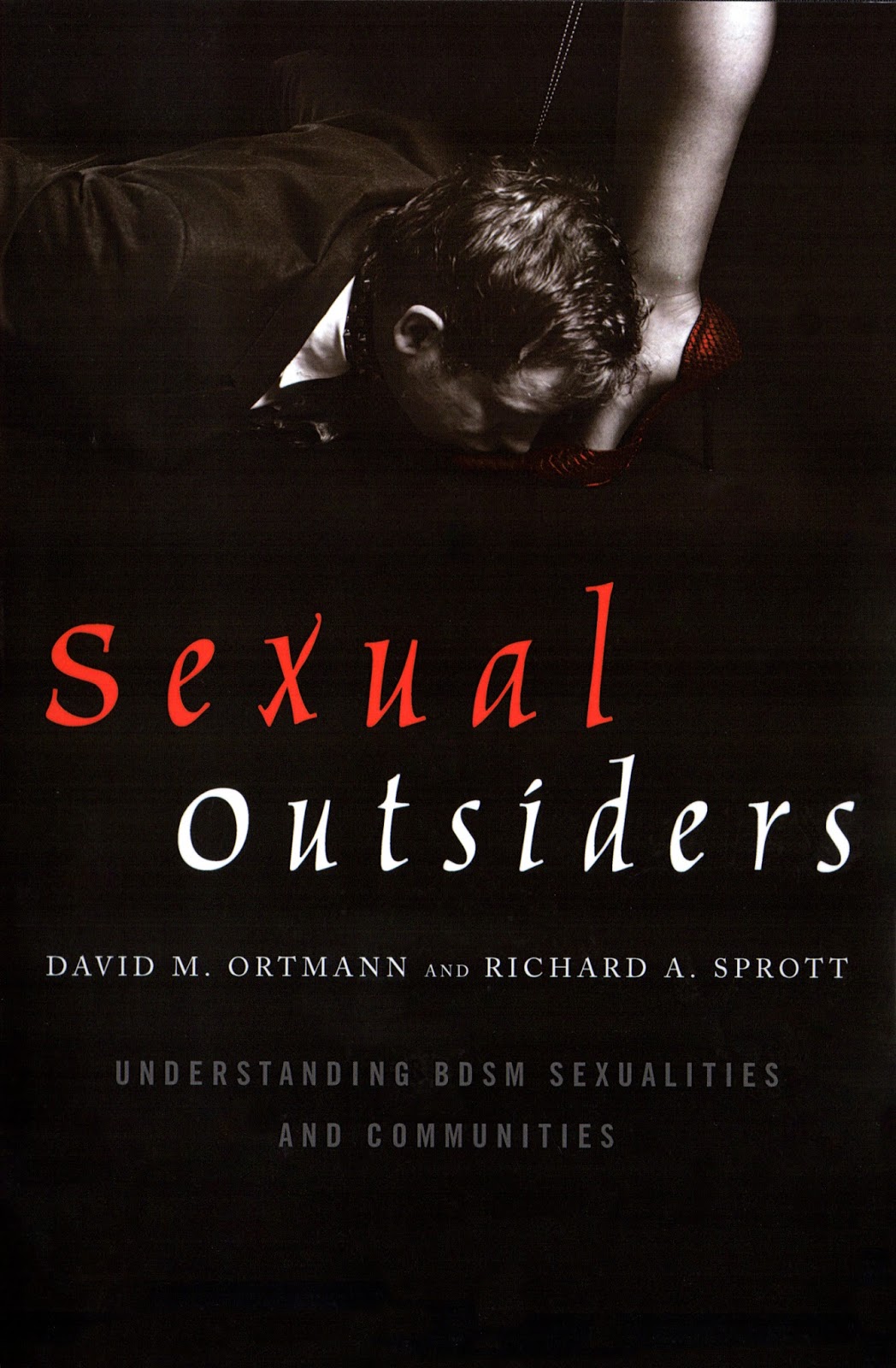
Leather Literature Review: Sexual Outsiders by David Ortmann and Richard Sprott

(Published in Lavender Magazine, Issue #478, September 26, 2013)

When your humble columnist was getting into leather (many, many years ago), the go-to book for newly minted gay leathermen was Larry Townsend’s The Leatherman’s Handbook. This book was, to say the least, enlightening. But I would not have wanted to show it to my therapist at the time, to say nothing of my parents or other family members.

My, how times have changed. Sexual Outsiders: Understanding BDSM Sexualities and Communities is a great new resource suitable for multiple audiences including those curious about or newly into leather, BDSM, fetish and kink—and, perhaps, their therapists and loved ones as well. For all these readers, authors David M. Ortmann and Richard A. Sprott have written a book that is a modern, reasoned, evenhanded introduction to the alternative sexual worlds of leather, BDSM, fetish and kink.

Ortmann and Sprott have a wealth of expertise to share. Ortmann is a psychotherapist and sex therapist in private practice, and much of the book consists of fascinating personal stories of some of his patients. In many instances, these stories are presented in the patient’s own words.

Sprott is a research psychologist and the executive director of the Community-Academic Consortium for Research on Alternative Sexualities (CARAS), an organization dedicated to furthering scientific investigation and scholarly analysis of understudied sexualities. And indeed, the book makes the very clear point that leather, BDSM, fetish and kink are woefully understudied, and that the many gaps in society’s understanding of these alternative sexualities have many negative consequences.

The authors use the personal stories in the book to illustrate the tremendous variety of people who make up the leather/BDSM/fetish/kink community, as well as to show how that community works. A large part of Ortmann’s and Sprott’s message is that this community has, in fact, developed around these alternative sexualities. This community is large, widespread and sophisticated—and a tremendously valuable resource for its members. Several times throughout the book, the authors stress the undesirability of trying to do BDSM in isolation and the desirability of participating in this community as a way of enhancing one’s kink journey.

Sexual Outsiders is written to appeal to several different audiences:

• The book could serve as a good basic introduction to leather, BDSM, fetish and kink for people new to, or curious about, these alternative sexualities.

• It could serve the same purpose for therapists and other health professionals responsible for the care and treatment of kinky people.

• Readers who do not identify as kinky, but who have a family member or friend who does, will find answers to many of the questions they may have.

• Finally, longtime members of the leather/BDSM/fetish community will enjoy reading the personal stories of the people profiled in the book, and will find the authors’ commentary throughout the book thought-provoking.

(Here’s a private tip for longtime community members: As you read this book, try to put yourself in the position of someone new to the community, or even outside the community. Your empathy, as well as your appreciation for what the authors have created, will increase greatly.)

Because the book is addressed to so many different audiences, however, some readers might encounter challenges. Although the authors’ writing style is generally approachable, readers who are not therapists or mental-health professionals may be put off by instances of therapist-speak sprinkled throughout the text. Similarly, readers not acquainted with the basics of Freudian, or especially Jungian, psychology may occasionally feel out of their depth.

But these are, in the end, minor quibbles. In Sexual Outsiders Ortmann and Sprott have created a worthwhile addition to the leather/BDSM/fetish/kink community’s canon of literature about itself, as well as a useful contribution to the scholarly and academic literature about alternative sexualities.

(Sexual Outsiders: Understanding BDSM Sexualities and Communities by David M. Ortmann and Richard A. Sprott. 173 pp. Lanham, Md.: Rowman & Littlefield Publishers, Inc.)